
Author: Yunus Yaldiz, PhD — Research Associate, Bundestag
The attack by Azerbaijan on the Autonomous Republic of Artsakh (also known as Nagorno-Karabakh), which violated international law, and the subsequent 44-day war took place from September 27 to November 10, 2020. During this war, approximately 5,000 soldiers on the Armenian side were killed. For Armenians, a small nation of fewer than three million people, this represents the loss of an entire generation of young men.
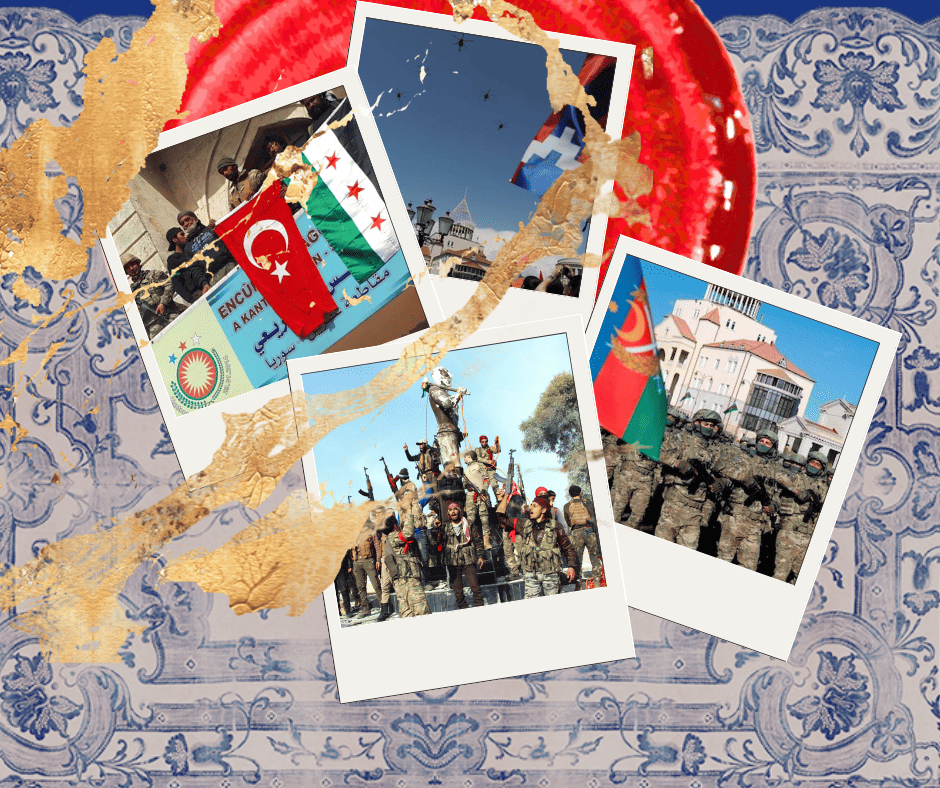
As part of Azerbaijan’s assault on a region that has been inhabited predominantly by ethnic Armenians for millennia, Azerbaijan — with the assistance of Turkey — deployed between 2,000 and 4,000 mercenaries, many of whom originated from the jihadist milieu of the Syrian National Army (SNA, formerly the FSA). These mercenaries, financed, coordinated, and flexibly deployed by Turkey, represent a new threat to the MENA region and the Caucasus and have already been used in Libya, Syria, and Nagorno-Karabakh/Artsakh. Thereby, Turkey presents itself as coming to the “aid” of its “brother state” Azerbaijan.
That the deployment of jihadist and other mercenaries constitutes a violation of international law has been submitted, together with evidence, by the Republic of Armenia to the European Court of Human Rights (ECtHR).1 Especially for Armenians — who had already endured genocide in 1915/16 at the hands of the Young Turks and earlier in 1895/96 under Ottoman Sultan Abdulhamid II, during which nearly two million Armenians were exterminated and displaced — this renewed displacement and killing by Turkey and Azerbaijan has revived memories and traumas associated with those earlier genocides and fears of being erased.
The fact that the international community in most part ignored the ethnic cleansing of 2020 demonstrates that the Republic of Armenia is, and will remain, on its own. The use of jihadist mercenaries in this attack and the subsequent ethnic cleansing of Artsakh (around 120,000 ethnic Armenians were forced to flee their homeland) represents a form of warfare and tactical approach that poses a dangerous and destabilizing threat not only to the entire Caucasus region but also to other conflict zones worldwide. For Artsakh and the neighboring Republic of Armenia, this is particularly significant, as there is no evidence that these jihadist mercenaries left the region. This suggests that jihadists were resettled there by Azerbaijan, creating a serious security risk for the region, as we will see later on.
To better understand who these mercenaries are, we will take a closer look at their background.
How Do We Know About the Use of Jihadists in the Artsakh/Karabakh Conflict?
Two Syrian mercenaries captured by Armenia during the 44-day war confirmed that Turkish military specialists had arrived to train them and prepare them for deployment in Artsakh. They further reported that no decisions were made without these specialists and that additional foreign fighters were present within their units, fighting alongside Azerbaijani military forces.2
The German weekly magazine Der Spiegel also reported that mercenaries from the Murad Brigade, part of the FSA, were deployed first in Syria and later in Artsakh, supported and financed by Turkey. Due to a lack of regional background knowledge, Der Spiegel unfortunately failed to recognize that Armenia is not supported by Russia, as claimed. This is evident from the inaction of Russian troops stationed in the region during Azerbaijan’s illegal attack. Artsakh and Armenia were left to fend for themselves. Throughout its history, Russia has sold weapons to both sides and remained silent during the attack.
Investigations by Der Spiegel further revealed that Turkey had sent at least 1,000 Syrian mercenaries and drones to the region, a fact confirmed independently by several mercenaries. Geolocation data corroborates these statements.3
The second major brigade deployed by Turkey and Azerbaijan alongside the Murad Brigade was the Hamza Brigade, which had previously fought in Libya. The commander of this brigade openly admitted this in an interview.
Additional fighters were recruited by Turkey directly from refugee camps near the Syrian-Turkish border, such as Afrin. They were promised a salary of $1,000, which served as an incentive for many, despite the fact that some of them had apparently never held a weapon before. They were transported via Gaziantep to Ankara and Istanbul, from where they were flown to Baku and subsequently brought across the Azerbaijani border into Artsakh.
The Syrian human rights organization Syrians for Truth and Justice (STJ) documented that Turkey sent 2,580 Syrian fighters to Azerbaijan, of whom 293 were killed in Artsakh. Each mercenary reportedly received 10,000 Turkish Lira for a three-month deployment. Families of fallen mercenaries were allegedly compensated with 25,000 Lira. Furthermore, as early as July 2020, 150 Caucasian jihadists of Turkic origin were reportedly transferred from Idlib to Azerbaijan to fight in Artsakh.
This planning demonstrates that Azerbaijan had been preparing the attack for months, if not years, in line with its long-term military buildup, and was willing to use any means necessary — including jihadists and Turkish and Israeli4 drones — to seize the territory.
An SNA commander commented: “Those who stayed in Azerbaijan are Caucasian jihadists with Turkmen origins. They are granted Azeri nationality. As for Syrians and Arabs, they all returned to Syria.”5
The mentioned Caucasian jihadists originate from the Islamist group Ajnad al-Kawkas, which mainly fought in the mountainous regions near Latakia and Idlib, areas then and now controlled by Hay’at Tahrir al-Sham (HTS). The current Syrian power structures of HTS, the SNA, and their subgroups maintain close relations with the Turkish state — clearly evident in the suppression of Kurdish forces of the Syrian Democratic Forces (SDF).
Additional mercenaries deployed in Artsakh came from the Suleiman Shah Brigade (also known as al-Amshat), Faylaq al-Majd, and Faylaq al-Sham. Their deployment began on September 22, 2020 — five days before the invasion.
It has also been documented that 25–30 Uyghur fighters were flown from Antakya to Syria, where they were trained and instructed near al-Janudiya by Turkish trainers for combat operations. An additional 250–300 Turkmen mercenaries from the Murad and Suleiman Shah Brigades were present at the same location. On September 27, they traveled from Syria via Gaziantep to Baku and were subsequently transferred to Artsakh.
In addition to these mercenaries, fighters from Ahrar al-Sham and Jabhat al-Nusra were relocated from Afrin to Azerbaijan and then to Artsakh in coordination with the Turkish intelligence service. During investigations conducted by the Office of the Prosecutor General of the Republic of Armenia on November 27, 2020, it was determined that more than 2,000 mercenaries were recruited for payment by the Sultan Suleiman Shah jihadists, transferred to Azerbaijan, and integrated into the war effort, with the group’s leader personally directing combat operations on site.6
American journalist Lindsey Snell was among the first to investigate Turkey’s coordinated deployment of jihadist mercenaries to Artsakh. Based on Syrian sources, she found that 2,000 jihadists from the two largest Syrian militias (Hamza and Sultan Murad) were sent to Artsakh by Turkey. Armenian armed forces inflicted heavy losses on them, but stood no chance against Azerbaijan’s modern military drone technology. According to Snell, these mercenaries were stationed in Azerbaijani military camps.7
Although international reporting has established that Turkey supported Azerbaijan in this war8 and likely encouraged the attack — something even Erdoğan’s presidential spokesperson acknowledged by stating, “Azerbaijan is not alone; Turkey stands by its side and Azerbaijan enjoys our full support” — Turkey continues to deny any involvement. No sanctions were imposed on Turkey by the international community. As a result, Azerbaijan has since attacked Armenian sovereign territory (e.g., Goris, Jermuk) from September 13, 2022 onward, advancing further to shift borders.9
The Groups
The Sultan Murad Brigade is a Turkic-origin jihadist group with approximately 9,000 fighters. It is part of the SNA and controlled by Turkey. This control is evident in its stated mission of fighting the PKK and YPG and its current operations against the SDF. Members of this group have also fought as mercenaries in Libya. Since 2018, it has been led by Fahim Ertugrul Isa,10 now commander of the Northern Syrian Army based in Aleppo.11 It can be assumed that this group will continue to be deployed throughout crisis regions, while the international community appears unwilling or unable to act.
The brigade is notorious for mass rapes of Kurdish women prisoners of war, forced marriages, and routine violence against civilians.12 The UN has condemned the brigade — alongside allied Faylaq al-Sham and Faylaq al-Majd — for their practice of recruiting child soldiers.13
The Hamza Division, also part of the SNA and thus under Turkish control, is known for war crimes such as torture, rape, abductions, and the murder of prisoners of war. Its leader, Sayf Bald (aka Sayf Abu Bakr), is a former ISIS terrorist and member of various FSA militias.14
The Suleiman Shah Brigade, also known as Amshat (named after its founder Muhammad al-Jassim, aka Abu Amshat), is another Turkish-backed militia within the SNA structure. It is notorious for torture, abductions, rape, and violence against civilians, particularly in Afrin, and reportedly has over 2,000 fighters.15
Ajnad al-Kawkas is a Chechen Islamist militia that fought alongside HTS. Its fighters were originally part of Ansar al-Sham. Since its founding in 2015, it has collaborated with other jihadist groups such as the predecessor of HTS, the Nusra Front, and the Turkistan Islamic Party. Fighters from this group are often veterans of other conflicts, particularly Syria, and while they seek the establishment of an Islamic caliphate or emirate, they do not appear to have direct ties to ISIS.16
The Faylaq al-Majd Brigade was also a Turkish-backed militia and part of the FSA/SNA. Like Faylaq al-Sham and other Turkey-supported groups, it was deployed in the 2018 capture of Afrin against the SDF. It is infamous for kidnappings, torture, mutilations, and other war crimes. Faylaq al-Sham emerged in 2014 as an apparent alliance of Syrian Islamists who were not aligned with al-Qaeda. Its fighters also participated in the Libyan civil war. The group collaborates with larger jihadist formations such as Jaysh al-Fatah, is supported by Turkey, and played a key role in the capture of Afrin.
The deployment of all these Turkish-backed jihadist groups during the 44-day war — and previously in Syria and Libya — demonstrates a now well-established and reliable modus operandi of the Turkish government and its self-proclaimed brother state. Whether they are displacing or killing democratic Kurdish representatives in Syria, Armenians in Artsakh, or other ethnic groups makes little difference.
Conclusion
War crimes did not end with the invasion of Artsakh and the recruitment and deployment of mercenaries and jihadists. Azerbaijani soldiers shared videos on Telegram and Instagram showing torture, beheadings, mutilations, and other crimes against Armenian prisoners of war. A common practice was cutting off the ears of prisoners or the dead and keeping them as trophies.
In addition to the use of chemical weapons (phosphorus) and cluster munitions, journalists, civilians, and civilian infrastructure — such as residential buildings, schools, hospitals, power plants, and Armenian cultural monuments including centuries-old churches and cemeteries — were deliberately targeted. Following the conquest, these cemeteries and churches were systematically destroyed following the Turkish model (1915 to the present),17 leaving no trace or evidence of the millennia-old Armenian civilization — just as after the genocide of 1915.18
The same fate awaits Armenian cultural monuments in Artsakh, representing an irreversible loss of human civilizational heritage. However, in times of EU oil and gas agreements with Azerbaijan, this seems to concern few.19
What the international community should do to halt further expansionist ambitions and the described practice of using mercenaries remains the most pressing question. Turkey appears to have adopted and expanded Iran’s mercenary strategy (Iraq, Syria, Lebanon) and applied it in Syria, Libya, and Artsakh. The Middle East and large parts of the Caucasus have already been permanently altered or destroyed by militias backed by Iran, Turkey, and Russia.
This approach will continue, as the international community appears to lack both interest and a sense of responsibility toward its former allies. In the eyes of most Armenians and Kurds, it has completely lost its credibility.
Notes
- https://hy.armradio.am/archives/377709 ↩
- https://cyberleninka.ru/article/n/mercenary-participation-in-the-2020-44-day-war-in-artsakh-and-its-impact-on-the-international-security-system ↩
- Spiegel.de | Oryxspioenkop.com | Tagesschau.de ↩
- NZZ.ch ↩
- stj-sy.org ↩
- https://cyberleninka.ru/article/n/mercenary-participation-in-the-2020-44-day-war-in-artsakh-and-its-impact-on-the-international-security-system ↩
- Armenpress.am | Civilnet.am ↩
- Open involvement documented by international media including France 24, The Guardian, BBC, the Syrian Observatory for Human Rights, and others, as well as by the United Nations Working Group on the use of mercenaries and private security companies. ↩
- evnreport.com ↩
- counterextremism.com ↩
- x.com/fehimisa1 ↩
- counterextremism.com ↩
- UN Document G20/210/90 ↩
- counterextremism.com ↩
- counterextremism.com ↩
- counterextremism.com ↩
- Dickran Kouymjian: The Destruction of Armenian Cultural Monuments: Its Significance for World Heritage Preservation. In: In Noah’s Country. Sydney 2015. ↩
- as.cornell.edu ↩
- ec.europa.eu ↩